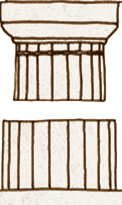
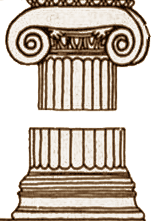
Keep a little mystery in your trip planning: Explorer Picture Mode shows a stylized version of every place instead of the real photo, so you can go by the description and reviews first and picture it your own way -- reveal the real photo any time by flipping the switch off, or just for one place at a time from its own page.
Create a free account to pick your own style (Vintage, Oil Painting, Black & White) and have it remembered next time you visit.
Acropolis of Athens
9.2/10
Editorial rating
/10
traveler ratings
Architecture
Changed
The Doric order is the style most used across the Acropolis's monuments, including the Parthenon itself -- the oldest and plainest of the classical Greek orders, with thick, unadorned columns (a base-diameter-to-height ratio of roughly 1:6) and sharply cut fluting, no separate column base, and a severe, martial character suited to the Acropolis's largest buildings.
The Ionic order also appears throughout the site, more slender (a ratio closer to 1:9) and more ornate, with distinctive scroll-like volutes at the top of each column. It's used in smaller buildings like the Temple of Athena Nike and the Erechtheion, and even appears inside the otherwise Doric Parthenon -- a deliberate mixing of styles that was itself a real architectural innovation for its time.
Site Plan and Features
Changed
The Propylaea
The upper structure of the Propylaea. - By Davide Mauro
The Propylaea, built between 437 and 432 BCE, is the monumental gateway to the Acropolis. The building consists of the main structure flanked by two wings. Inside the buildings, Doric and Ionic columns divided the spaces. Lavishly painted walls or panels in the north building gave the entire structure its name.
The main temples
The three main temples on the Acropolis are all built upon previous temples' ruins, all dedicated to the city's patron goddess Athena. This is reflected by inscriptions found in pottery, vases, and statuary from the archaic period that show the cult's early period.
The Temple of Athena
The Temple of Athena Nike. - By Jebulon
The Temple of Athena Nike, constructed in approximately 420 BCE, is built in the Ionic style. Inside, the temple features an open-air or amphiprostyle with a row of four columns placed in front of each wall. Three walls feature a different frieze of battle scenes, while the east wall depicts a conference of the gods.
The Erechtheion
The upper part of a column at the Erechtheum temple in the acropolis of Athens [Report image]
The Erechtheion was the essential place of worship of the Acropolis since its origins; intimately linked to the foundation and the durability of the City, it will always remain so. As a result, it is a complex assembly of several sanctuaries; it nevertheless offers a certain architectural unity through the grace of its porticoes and the finesse of its decoration. Its construction was carried out in two stages (421-414 and 409-406). The identity of the architect of this particularly complex building remains unknown. The building, in the Ionic style, more or less reproduces the interior layout of the old temple of the Archaic period, to which two additional elements have been added, the northern portico and the porch of the Maidens (or Porch of the Caryatids), to the south.
Porch of the Maidens
Picture of the Porch of The Maidens at the Acropolis of Athens [Report image]
This portico, a major work of Hellenic art, is the most original motif of the Erechtheion and a kind of funerary canopy over the tomb of Caecrops, the Snake King, one of the mythical founders of Athens. Six statues of young girls, perhaps from the workshop of the Athenian sculptor Alcamenes, gracefully perform their supporting function. They are upright, dressed in long Ionian tunics, and wear a circular capital as a headdress. This portico may have served as a tribune from which certain officials could watch the parade and the panathenaic ceremonies while at the same time masking the staircase linking the Erechtheion to the Acropolis terrace.
The Parthenon
The Parthenon in the Acropolis of Athens, Greece. [Report image]
The most famous building at the Acropolis is the Parthenon. The building itself is designed in the Doric order and constructed almost entirely from Pentelic marble. The building was completed in 438 BCE, and the religious decoration was finished in 432 BCE. Like the other temples in the Acropolis, the Parthenon is dedicated to Athena Parthenos.
The Parthenon is a prime example of the Doric architecture of the Classical period (ca. 480-323 BC). It was Ictinus, a Greek sculptor, not an architect, who said that "artistic achievement is the result of meticulous precision in a multitude of arithmetical proportions". In its whole aspect, there are calculated dosages of parts and rhythmic correspondences. Then from the whole to the parts: the areas of the entablature are divided into logical and harmonious relationships.
The Parthenon suffered severe damage during the 1600s when an explosion occurred inside the temple. Until that time, the Parthenon had withstood time in good condition. In the 19th century, its devastation was complete when Lord Elgin, the English ambassador to Constantinople, stole most of the remaining friezes and other decorations. These items remain on display at the British Museum in England.
Landscape
Changed
The Acropolis occupies a flat-topped limestone outcrop rising roughly 150 meters above sea level and around 70 meters above the surrounding city, its steep cliffs falling away sharply on three sides -- a natural defensive position that explains why the hill was fortified and settled long before any temple stood on it.
From the summit, the view takes in central Athens and several of the city's other prominent hills -- Lycabettus, the highest point in Athens itself, along with the Areopagus and the Pnyx, both sites with their own roles in Athenian political history -- and on clear days extends across the plain of Attica toward the sea.
Millennia of quarrying, construction, and continuous habitation have left the rock itself heavily modified, but its underlying limestone -- the same reason a spring, the Clepsydra, could be found on the hill in antiquity -- is still what the entire site rests on.