

Anagni Cathedral
Last updated on October 8, 2026Why visit Anagni Cathedral
The reason to come to Anagni is underneath the cathedral rather than inside it. The crypt of St Magnus carries 540 square metres of painted vault and wall, laid out as the whole story of human salvation from creation to judgement, and it is complete enough that it gets called the Sistine Chapel of the Middle Ages without much argument. The strangest part of it is not biblical at all: one cycle sets out the creation of the world as a proportional union of the four elements, with Hippocrates and Galen standing in the picture and the Platonic theory of the elements behind it. Above ground, this was where popes spent their summers, excommunicated two emperors and an antipope, and made saints of Bernard of Clairvaux and Clare of Assisi.
Visit if you:
- want medieval fresco in quantity, in situ, and without a crowd in front of it
- are interested in the point where medieval theology and Greek medicine were painted on the same ceiling
- care about the papacy as a political institution rather than a devotional one
- like Cosmatesque floors, and want two of them in one building
- use a wheelchair and have been told too often that a crypt is out of reach -- this one is not
Skip it if you:
- are coming for Renaissance or Baroque painting -- almost everything of weight here was finished before 1300
- cannot book ahead: reservation is compulsory for everyone, individuals included, and is only valid once the museum confirms it
- expect the site of the Outrage of Anagni to be standing -- the rooms where Boniface VIII was seized adjoined the cathedral through the cloister and are gone
Quick facts
- Type: Church, Sacred Place
- Local name: Cattedrale di Anagni (vedi la pagina italiana)
- Visitor access: Open to visitors
- Architectural style: Romanesque exterior; Gothic-Lombard interior after 1250
Visit responsibly
The crypt's 540 square metres of fresco are eight hundred years old and underground, where humidity and the breath of visitors are the working variables. Where photography without flash is permitted, flash is not a formality being enforced for its own sake; where a route is marked away from the walls, the distance is the conservation measure.
The floors are exhibits here, not surfaces. Both pavements are original Cosmatesque mosaic -- the church's of 1231, the crypt's of 1224-1231 -- and they are walked on, which is unusual and is why the loose tesserae at the edges matter. Nothing picked up from a floor in this building is a souvenir of no consequence.
This is the cathedral of a working diocese and a parish, not only a monument. Services run, and the crypt altars hold the bodies of the saints the town is named for in its own devotions; a visit during one is a visit to someone else's.
Anagni sees far fewer visitors than its contents justify, and the town around the cathedral is ordinary and lived in. Eating and buying in it, rather than treating the hill as a stop between Rome and Naples, is what keeps a place of this size able to host visitors at all.
Where it is
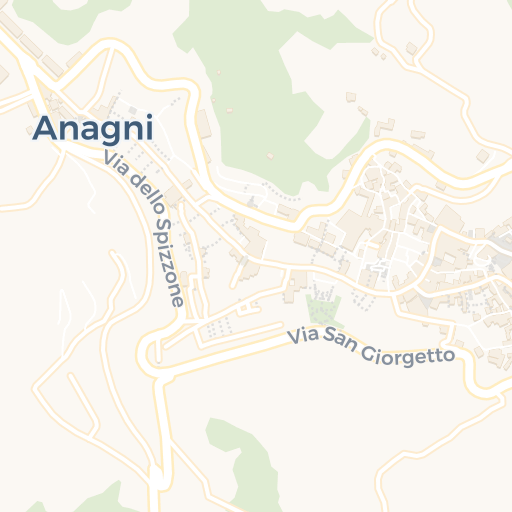
Get directions Open in Apple Maps
© OpenStreetMap contributors · © CARTO · 41.74284, 13.16197
Plan your visit
The cathedral is the seat of the Diocese of Anagni-Alatri and holds the rank of minor basilica, and the visitable route is run as the Museo della Cattedrale di Anagni (MuCA). One ticket covers the whole circuit: the Library, the Chapter Hall, the New Sacristy and the sacristies, the Ancient Treasury, the Chapel of the Saviour, the Caetani Chapel, the ambulacrum, the oratory of Saint Thomas Becket, the crypt of Saint Magnus, the lapidarium and archaeological collection, and the bookshop.
Booking is compulsory, for everyone. Groups must book through the museum's own form and must be accompanied either by an internal guide, requested at the same time, or by a licensed guide carrying a professional card. Individuals must also book -- by telephone, email, social channels or the form -- and the reservation counts only once museum staff have confirmed it. Once inside, you can go round on your own, since the route carries information panels and captions, or use the MuCA audioguide app on your own phone, for which earphones are required. A guided visit must be booked on the form and costs extra on top of admission.
The museum opens every day, 09.00-13.00 and 15.00-18.00 from November to March, and 09.00-13.00 and 15.00-19.00 from April to October. Last entry to the route is 60 minutes before closing. Visits stop during services; Sunday Mass is at 11.30, and on Sunday mornings the ticket office closes at 10.30 and reopens at 15.00. Admission is 10.00 euro full and 7.00 euro reduced -- for booked groups of fifteen or more, residents of Anagni on production of ID, EU university students enrolled in Letters and Philosophy, Theology, Architecture or Conservation of Cultural Heritage, and carers of disabled visitors. A special reduced ticket of 4.00 euro covers secondary school groups and 11-to-18-year-olds. Entry is free for certified disabled visitors, primary school groups, children up to ten, licensed guides accompanying booked groups, and teachers at a rate of one per ten students. (Prices and hours as published by the museum on 8 October 2026 -- confirm before travelling.)
Verified against Museo della Cattedrale di Anagni (MuCA), October 2026.
When to visit
Anagni is an hour from Rome and does not run on a tourist season, so the calendar here is about light and temperature rather than crowds. April to June and September to October are the comfortable months. The crypt is the main event and it is underground, which cuts both ways: it is the one part of the visit that is equally good in August heat and in February, and the one part that is dim at any hour, so nothing is gained by timing the day around it. The upper church is a different matter -- its three apses face west, and late afternoon is when the light reaches them. Winter is quiet to the point of emptiness, with the caveat that opening hours in small Italian cathedral towns contract outside the summer, so a weekday in January is worth confirming before travelling.